
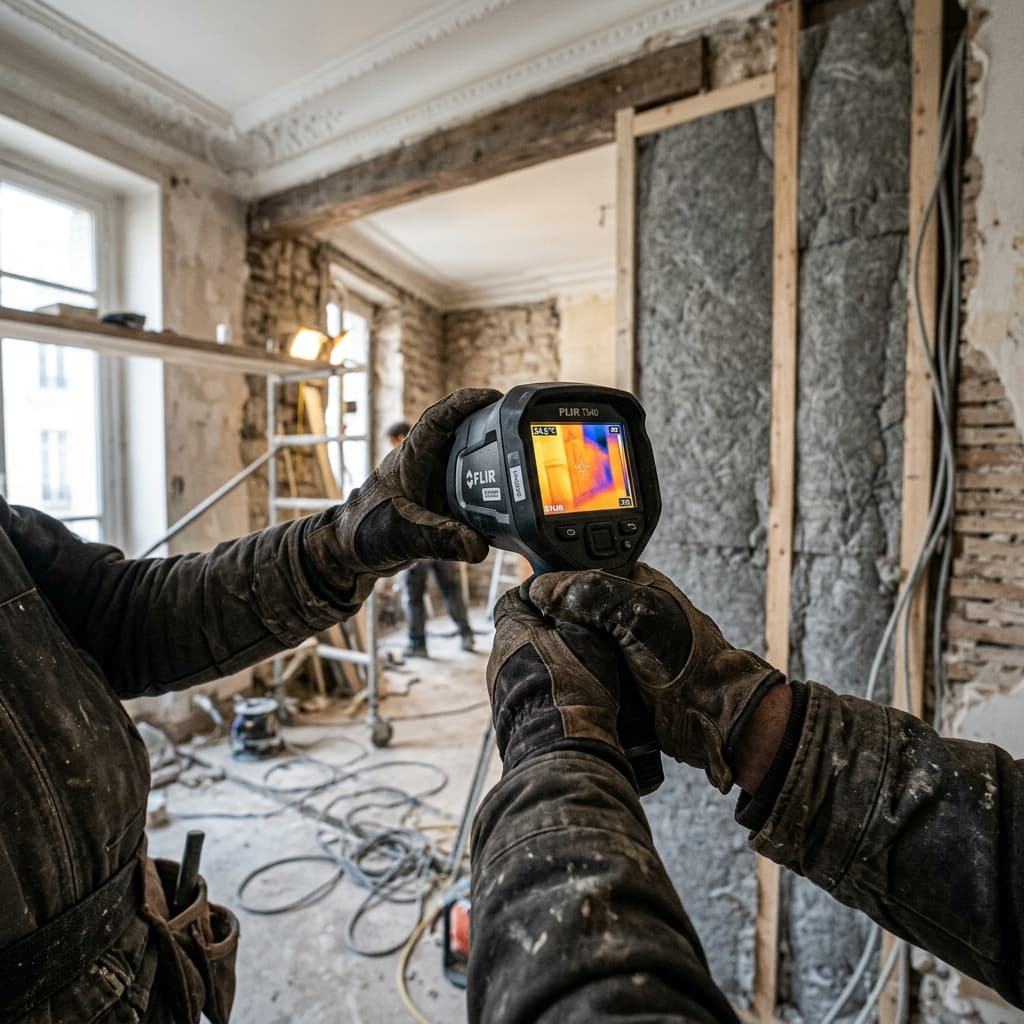
1. Understanding French DPE Laws & Rental Bans for International Owners
The French Diagnostic de Performance Énergétique (DPE) evaluates energy consumption (kWh/m²/year) and greenhouse gas emissions. Properties rated G or F are subject to immediate rental caps and bans across Paris. Foreign investors acquiring historic stock must execute a comprehensive energy retrofit to legally lease their property or maximize resale valuation.
LUPOQ Rénovation conducts certified thermal audits before purchase or work commencement, calculating exact energy gains needed to transition your property directly from Class F/G to Class B or C.
2. Thin Thermal Insulation Technology: Saving Space & Preserving Moldings
LUPOQ Rénovation utilizes state-of-the-art vacuum insulation panels (VIP) and high-density aerogel linings measuring less than 3 to 5 cm in thickness.
Our master restoration teams carefully dismount historic wood wainscoting and plaster cornices, install high-performance thermal barriers, and reassemble original features seamlessly, leaving zero visible trace of technical intervention.
3. Silent Concealed Heat Pumps (HVAC) & Thermal Double Glazing
Gas boilers are being phased out in Paris. LUPOQ Rénovation specializes in installing compact, ultra-silent ducted heat pumps (HVAC) integrated inside custom joinery or drop ceilings. Condensate drain lines and refrigerant piping are completely concealed.
To eliminate window heat loss while satisfying the Architectes des Bâtiments de France (ABF) heritage codes, we install custom wood double-glazed windows with vacuum-insulated glass that replicate original 19th-century profiles down to brass cremone fasteners.
4. Complete Turnkey Remote Management & French Ten-Year Guarantee (Garantie Décennale)
For overseas investors residing in North America, Asia, or the Middle East, LUPOQ Rénovation provides a seamless turnkey experience. We handle all ABF municipal filings, co-ownership board (Syndic) approvals, and thermal certifications.
You receive weekly HD video updates and thermal imaging reports verifying insulation continuity. All LUPOQ Rénovation energy retrofits are backed by fixed-price contracts and the mandatory French 10-Year Insurance (Garantie Décennale).
Why the energy label became a commercial fact
For years the energy performance certificate was a piece of paper attached to a sale and read by nobody. That changed when the law began prohibiting the letting of the worst-performing housing, category by category, on a published timetable. A rating that used to be a detail now determines whether a property can legally be let.
For a foreign investor this reverses the usual order of due diligence. The rating is no longer something to check after the purchase; it is one of the first questions, because it decides whether the asset produces income and what has to be spent before it does.
What actually moves a rating
The certificate is calculated from the building fabric and the systems, not from the decoration. Replacing a kitchen changes nothing. What moves it is the envelope and the plant: insulation of walls, roof and floors, the performance of the glazing and the joinery, the heating system and its controls, the hot water production, and ventilation.
On a Paris apartment the owner controls only part of that. The façade, the roof and often the heating plant are common property, and improving them requires a decision of the co-ownership. The parts an individual owner controls are the joinery, internal insulation where it is feasible, the emitters, hot water and ventilation.
The internal insulation trap
The obvious response to a poor rating is to insulate the walls from the inside, because it is the only side the owner controls. On an old Paris building this is where projects go wrong. The walls are lime, plaster and rubble stone, and they manage moisture by letting it pass. Sealing the inner face with an impermeable system traps it, and the wall deteriorates from behind.
Where internal insulation is used it must be a breathable system, correctly detailed at reveals and floor junctions where the cold bridge otherwise relocates rather than disappearing. And it costs ceiling depth and wall depth, which on a Haussmann apartment has to be weighed against the mouldings and the proportions.
Ventilation is not optional
Every improvement to airtightness reduces the accidental ventilation that an old apartment relied on. Replace the windows, insulate, seal the gaps, and the moisture generated by ordinary living has nowhere to go. It condenses on the coldest surfaces and mould appears, typically in the second winter, in the corners of external walls and behind furniture.
A controlled ventilation strategy is part of the same work, not a later addition. Skipping it is the most common and most expensive mistake in energy renovation.
Sequencing it around a purchase
The efficient order is to establish the rating and the reasons for it before completion, to identify which improvements are within the owner's control and which require a co-ownership vote, and to programme the individual works so they happen in one site visit rather than three.
Work that requires the assembly's authorisation should be requested as early as possible, because assemblies meet on their own calendar and a missed meeting can cost a year.
Frequently asked questions
Can I upgrade a G-rated Haussmannian apartment to Class B without losing floor area?
Yes. Using LUPOQ Rénovation's aerogel and vacuum insulation technologies, we achieve Class B performance with ultra-thin wall profiles of just 3 to 5 cm, saving up to 80% of interior space compared to standard insulation.
How do you handle ABF preservation codes for double-glazed windows in Paris?
We manufacture custom wooden windows that replicate historic molding profiles exactly while integrating vacuum double glazing approved by the Architectes des Bâtiments de France.
What guarantees protect foreign buyers during energy renovation?
All LUPOQ Rénovation projects include fixed-price contracts, guaranteed delivery dates, and full 10-year statutory insurance (Garantie Décennale) covering thermal and mechanical work.
Can I let the property while the works are done?
No, and it is rarely worth trying. The works that move a rating touch the envelope and the systems, which means the apartment is not habitable for the duration.
Will improving the rating pay for itself?
Judged only on energy saved, usually slowly. Judged on whether the property can be let at all and on what it is worth at resale, the calculation is different and much shorter.
Études de cas & chantiers à proximité (Paris)
Il a hérité d'un appartement sombre. 10 semaines plus tard, il ne le reconnaissait plus.
Son père lui avait laissé cet appartement rue de Grenelle. 95m². Plafonds à 3m20. Moulures d'origine. Et des années de cloisons rajoutées, de mauvaises décisions déco, de lumière sacrifiée.
Paris 4e · Commercial9 semaines pour livrer un bar Paris 4e. Avec un comptoir en laiton et bois massif fait à la main.
Quand Farida nous a appelés, elle avait une image précise en tête. Un comptoir chaleureux. Du laiton. Du bois massif. Une atmosphère qui donnerait envie de rester. Le problème : elle ouvrait dans 9 semaines.
Paris 6eUn duplex Paris 6e avec un escalier sur-mesure, un puits de lumière et 2 salles d'eau. Tout ça dans 110m².
L'appartement était fonctionnel. Pas beau. Deux niveaux mal connectés, une circulation étroite, une lumière naturelle quasi absente au niveau bas.
Related guides
Related guides
- The Ultimate Guide to Renovating a Haussmannian Apartment in Paris: Turnkey Excellence for Foreign Buyers →
- High-End Apartment Renovation in Paris: The Ultimate Guide for International Buyers →
- Historic Property Restoration in Paris: Blending French Heritage with Modern Comfort Standards →
- The Ultimate Guide to Renovating a Luxury Paris Apartment for International Buyers →
- Managing Your Paris Renovation Remotely: How LUPOQ Rénovation Keeps You in Control →
- Carrara Marble and Noble Materials in Parisian Luxury Renovation →
Test your apartment's value in 30 seconds!
Instantly calculate your Paris apartment's market value and capital gain potential following luxury turnkey renovation.
* Estimates based on prime Paris luxury real estate benchmarks. Exact renovation quotes are issued after confidential on-site engineering surveys within 48 hours.
Planning a Paris Renovation? 24/7 International Express Consultation
Time zone difference? Leave your project details below. Our bi-lingual engineering team will respond within 24 hours via Email or WhatsApp.